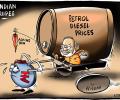
The Union government has collected Rs 94,181 crore through levy of excise duty on petrol and diesel in the first three months of the current fiscal on the back of a record tax on fuel that yielded 88 per cent higher revenue the previous financial year, the Lok Sabha was informed on Monday. Excise duty on petrol was hiked from Rs 19.98 per litre to Rs 32.9 last year to recoup gain arising from international oil prices plunging to multi-year low as pandemic gulped demand. The same on diesel was raised to Rs 31.8 from Rs 15.83 a litre, according to a written reply by Minister of State for Petroleum and Natural Gas Rameswar Teli in the Lok Sabha. This led to excise collections on petrol and diesel jumping to Rs 3.35 lakh crore in 2020-21 (April 2020 to March 2021), from Rs 1.78 lakh crore a year back, he said.

'Perhaps GST was too complex a system for the Indian economy at its present stage of development,' argues T N Ninan.

The government expects indirect tax collection to be lower than the Budget Estimate (BE) of Rs 13.38 trillion this fiscal year, despite prospects of netting goods and services tax (GST) in large amounts, Revenue Secretary Tarun Bajaj has said. "Indirect tax collection may see lower realisation than budgeted on account of cuts in excise and customs duties. "We could see a shortfall of about Rs 1.5 trillion on account of those," he told Business Standard.

Delhi ministers Manish Sisodia and Satyendar Jain on Tuesday resigned from the Cabinet, amid corruption allegations against them.
The net indirect tax collection in 2020-21 grew 12.3 per cent annually to Rs 10.71 lakh crore, thereby exceeding the target set in revised estimates, the Finance Ministry said on Tuesday. The mop-up through indirect taxes, which include GST, Customs and excise duties, was Rs 9.54 lakh crore in 2019-20. In the Revised Estimates (RE) for 2020-21, the target was set at Rs 9.89 lakh crore. Net collections from Goods and Services Tax (GST) stood at Rs 5.48 lakh crore during 2020-21, an eight per cent drop compared to Rs 5.99 lakh crore in the previous fiscal year.

Deputy Chief Minister Manish Sisodia holds as many as 18 of the total 33 departments, including education, finance and home.

Petrol price on Thursday was cut by Rs 6.07 per litre and diesel price by Rs 11.75 in Delhi as oil companies passed on a record reduction in excise duty rates to consumers. Buckling under pressure, the government had on Wednesday cut excise duty on petrol by Rs 5 per litre and that on diesel by Rs 10 a litre to give reprieve to consumers battered by record high retail fuel prices. Since states charge local sales tax or VAT not just on the base price but also on the excise duty levied by the centre, the total incidence of price reduction is higher.

The development comes after the resignation of Manish Sisodia and Satyendar Jain, the key faces of the city government and were instrumental in steering the national capital through the COVID-19 crisis.
A hotel in 1975, entry into paperboards in 1979, India's dominant cigarette maker, ITC, read the tea - or tobacco - leaves early, leveraged its enterprise strengths and stepped up the diversification agenda to create multiple drivers of growth. Some failed, some faltered, some were transformational, adding steadily to the top line. Now those efforts are making a difference: margins from non-cigarettes - FMCG, hotels, agri, paperboards, paper and packaging - are expanding and profits are kicking in more significantly than ever before.

The government has not divulged the amount of the fine to be imposed on first-time offenders.

For every rupee in the government coffer, 58 paise will come from direct and indirect taxes, 35 paise from borrowings and other liabilities, 5 paise from non-tax revenue like disinvestment and 2 paise from non-debt capital receipts, according to the Budget documents for 2022-23. According to the Union Budget 2022-23 presented in Parliament by Finance Minister Nirmala Sitharaman on Tuesday, goods and services tax will contribute 16 paise in every rupee revenue, while corporation tax will contribute 15 paise to each rupee earned. The government is also looking to earn 7 paise for every rupee from Union excise duty and 5 paise from customs duty. Income tax will yield 15 paise to every rupee collection.

India's top fuel retailers IOC, BPCL and HPCL together lost around $2.25 billion (Rs 19,000 crore) in revenue for keeping petrol and diesel prices on hold during elections in five states, including Uttar Pradesh, Moody's Investors Services said on Thursday. State fuel retailers did not revise petrol and diesel rates for a record 137 days despite prices of crude oil (raw material for producing fuel) rising to $120 per barrel compared to around $82 in early November when the hiatus began. "Based on current market prices, the oil marketing companies are currently incurring a revenue loss of around $25 (over Rs 1,900) per barrel and $24 per barrel on sale of petrol and diesel, respectively," Moody's said in a report.
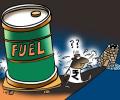
Finance Minister Nirmala Sitharaman on Monday ruled out a cut in excise duty on petrol and diesel to ease prices, which have touched an all-time high, saying payments in lieu of past subsidised fuel pose limitations. Petrol and diesel as well as cooking gas and kerosene were sold at subsidised rates during the previous Congress-led UPA government. Instead of paying for the subsidy to bring parity between the artificially suppressed retail selling price and the cost that had soared because of international rates crossing $100 per barrel, the then government issued oil bonds totalling Rs 1.34 lakh crore to the state-fuel retailers. These oil bonds and the interest thereon are being paid now.

'I believe the modified scheme is much more beneficial and simpler.'
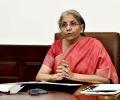
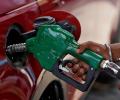
Amid record-high fuel prices, Finance Minister Nirmala Sitharaman on Monday said there is no proposal as of now to bring crude oil, petrol, diesel, jet fuel (ATF) and natural gas under the Goods and Services Tax (GST). When the GST was introduced on July 1, 2017, amalgamating over a dozen central and state levies, five commodities - crude oil, natural gas, petrol, diesel, and aviation turbine fuel (ATF) - were kept out of its purview given the revenue dependence of the central and state governments on this sector. This meant that the central government continued to levy excise duty on them while state governments charged VAT. These taxes, with excise duty, in particular, have been raised periodically.
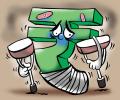
Nirmala Sitharaman has designed the revenue mix in such a way that while Centre's share in taxes would grow a massive 25 per cent, states' share would grow a dismal 6 per cent.

With the first quarter gross tax mop-up reaching Rs 5.6 lakh crore, Icra Ratings on Friday said the government is set to exceed the budgeted tax collection target of Rs 22.2 lakh crore for 2021-22, led by indirect taxes. The government has budgeted a modest 9.5 per cent growth in tax collections at Rs 22.2 lakh crore for FY22, over FY21 collections of Rs 20.2 lakh crore. However, despite the second wave of the pandemic, the April-June quarter tax collections rose to Rs 5.6 lakh crore, which is 39 per cent higher than Q1 of FY20.

Tamil Nadu, Kerala, West Bengal, Assam and the Union Territory of neighbouring Puducherry are likely to go to polls in April or May.

Fitch Ratings on Friday said it has revised the outlook on India's sovereign rating to 'stable' from 'negative' as downside risks to medium-term growth have diminished on rapid economic recovery. Fitch Ratings kept the rating unchanged at 'BBB-'.
However, it may still not change its stance on the policy rate as inflationary pressures are coming from high commodity prices.

The Union government's fiscal deficit works out to be Rs 5.47 lakh crore or 36.3 per cent of the budget estimates at the end of October 2021 on the back of improvement in revenue collection, according to the data released by the Controller General of Accounts (CGA) on Tuesday. The deficit figures in the current fiscal appear better than the previous financial year when the gap between expenditure and revenue had soared to 119.7 per cent of the last year's Budget Estimates (BE) mainly on account of a jump in expenditure to deal with the COVID-19 pandemic. In absolute terms, the fiscal deficit was Rs 5,47,026 crore at the end of October, the CGA said.
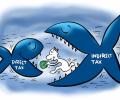
Before 2019, an estimated 22 million individual income-tax returns did not have to pay any taxes. But after the change in the exemption level, another 13 million individual tax returns did not require to pay taxes. Thus, of about 58 million returns, as much as 63 per cent or 35 million went out of the direct tax net, A K Bhattacharya points out.
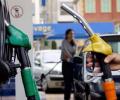
Officials from State-run refiners contend that savings from purchase of Russian oil are used to offset a part of the losses in revenues from selling transport fuels and LPG at State-set rates.

Shivakumar has got the all-important Major and Medium Irrigation and Bengaluru City Development, including the Bruhat Bengaluru Mahanagara Palike (BBMP), Bangalore Development Authority, Bangalore Water Supply and Sewerage Board, Bangalore Metropolitan Region Development Authority and the Bangalore Metro Rail Corporation Limited.
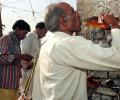
Incentives for industries have been rolled back and teachers have gone without salary for months as the state grapples with the after-effects of the ban
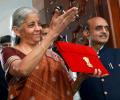
At the customary post-Budget media interactions, Finance Minister Nirmala Sitharaman and her topmost bureaucrats touched upon a number of issues. The minister said the government taxing income from digital virtual assets did not give them legitimacy and that issue was being dealt separately in the planned cryptocurrency Bill. She also expressed confidence that the Budget targets were achievable.
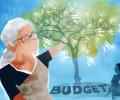
Finance Minister Nirmala Sitharaman will present the Union Budget for 2023-24 in Parliament on February 1. The Budget is a statement of the government's estimated receipts and expenditures for a fiscal year (April 1 to March 31). It's divided into Revenue and Capital Budget. The Revenue Budget includes the government's revenue receipts and expenditures while the Capital Budget includes its capital receipts and payments.

Security and intelligence agencies will soon be provided with a new platform which is technologically advanced, secure and helpful in dealing with new age criminals and anti-social elements, officials said on Wednesday.
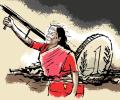
The Centre and states are likely to budget for higher market borrowings to the tune of Rs 2.3 lakh crore next fiscal even though the Union budget may peg a lower-than-expected fiscal deficit for the Centre at 5.8 per cent of GDP, says a report. Icra Ratings anticipates higher redemptions will lead to gross market borrowings of the Centre to rise to Rs 14.8 lakh crore and of the states to jump by Rs 1.6 lakh crore to Rs 9.6 lakh crore, taking the combined borrowings (of the Centre and the states) to Rs 24.4 lakh crore in FY2024, up by 2.3 lakh crore from FY23 combined. In FY23, the Centre's gross borrowings are budgeted at Rs 14.1 lakh crore and of the states at Rs 8 lakh crore, or a combined borrowing of Rs 22.1 lakh crore, according to the agency.
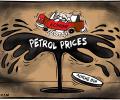
A proposal in the Union Budget 2022-23 to raise excise duty on dirtier, unblended retail petrol and diesel has met with some resistance from the petroleum ministry. However, finance ministry officials say no such communication arguing against the levy of extra duty on diesel has been received from the oil ministry. Until there are discussions between the two departments, the proposal will not be tweaked in the Finance Bill. The Rs 2 per litre additional excise duty proposed on unblended fuels in the Finance Bill will result in a uniform hike of diesel prices across the country from October 1.

India's gross tax collections soared to a record high of Rs 27.07 lakh crore in the fiscal year ended March 31, led by impressive growth in corporate tax and customs, taking the tax-to-GDP ratio to an over two-decade high of 11.7 per cent, Revenue Secretary Tarun Bajaj said on Friday.
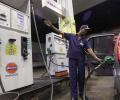
Consumption of petrol and diesel will contribute more than half of the Centre's exclusive share in GST in FY20, reports Abhishek Waghmare

Budget for 2022-2023 has returned to its agenda for protectionism in the name of creating a self-reliant India, points out A K Bhattacharya.

The government is also looking to earn 8 paise for every rupee from Union excise duty and 3 paise from customs duty. While, income tax will yield 14 paise to every rupee collection.

Health Minister Harsh Vardhan's recent request to Finance Minister Arun Jaitley - for an increase in tax on cigarettes from 45 per cent to 60 per cent in the coming Budget - seems to have had a serious impact on cigarette smokers' pockets.

Flagging higher fuel prices in many opposition-ruled states, Prime Minister Narendra Modi on Wednesday called it "injustice" to people living there and urged the governments there to reduce VAT in "national interest" to benefit the common man. Modi raised the issue of many states not adhering to the Centre's call for reducing the Value Added Tax (VAT) on petrol and diesel after his government slashed excise duties on them in November last, and asked them to work in the spirit of cooperative federalism in this time of global crisis. Higher prices in some states were also harmful for neighbouring states, he added.

CM Stalin has a procedural problem. Nominating new ministers would entail his having to seek formal permission from governor R N Ravi. Stalin does not want to interact with the person of this governor, as far as possible, predicts N Sathiya Moorthy.

Union Finance Minister Nirmala Sitharaman on Tuesday said the mass consumption items such as pulses, wheat, rice, flour, and curd will not attract the 5 per cent goods and services tax (GST) when sold loose, and not pre-packed or pre-labelled. The clarification came amid protests and widespread criticism by Opposition Members of Parliament over foisting GST on daily-use essentials and subsequent price rise. The all-powerful GST Council, chaired by the Union minister, had last month decided to impose GST on some mass consumption items to simplify the rate structure, which came into effect on Monday.

Excise exemptions may be whittled in Budget to offset higher govt salaries, pensions
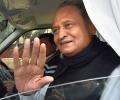
The 15 ministers were sworn in on Sunday for the expanded Gehlot cabinet, fulfilling a key demand of former deputy chief minister Sachin Pilot whose rebellion last year shook the state's Congress government.
